
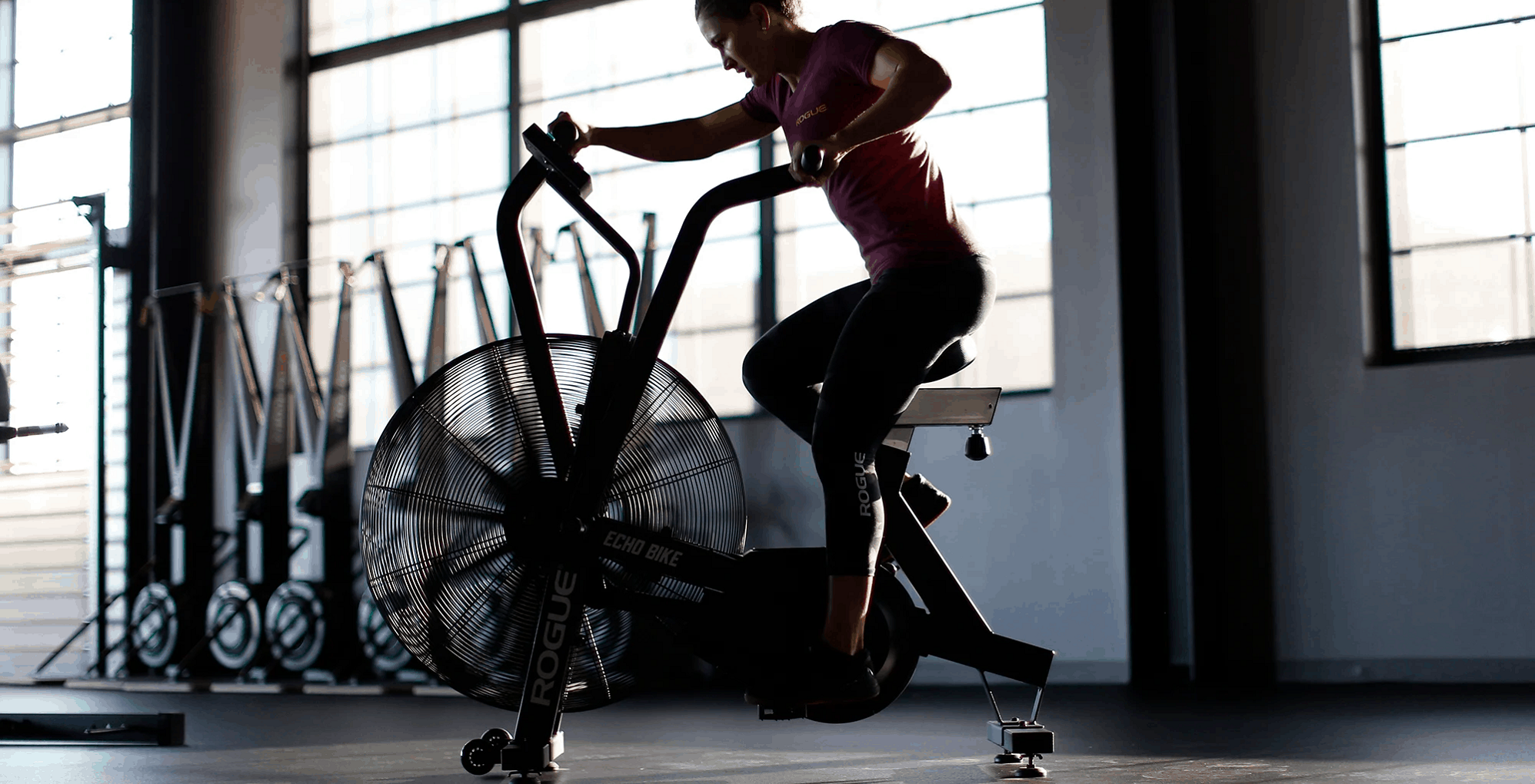
You’re about to take up some serious cardio, and not just any cardio, but CrossFit cardio. You’re serious about this, you want to get in shape, but… now you’re at a crossroad. One between the assault bike, and the Echo bike.
Question is, which one is going to work best for you? There are far more differences between these two bikes than one might think, but at the end of the day, it’s those differences that separate different types of athletes.
What is an Assault Bike?
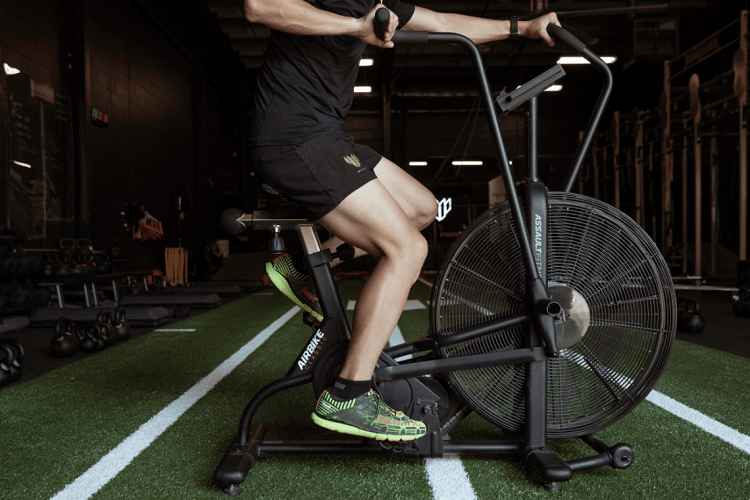
The assault bike is a stationary fan bike that allows you to use air resistance to push against the force of your legs on the pedals. The more you pedal, the more resistance you feel, so you’re able to scale your exercise without having to turn a dial or mess with a belt.
The assault bike is chain-driven, so that impacts the way that you feel resistance when you pedal on it and it’s an important detail. It’s designed to be an excellent cardio machine and lives up to its name.
Pros
- Rugged Construction: You can’t ignore the craftsmanship on this one, just like with the Echo. This bike is built to last with a relatively maintenance-free design, and solid parts that you can tell aren’t going to buckle on you. There’s a reason that it’s rated for up to 350 lbs of user weight—because it can handle it.
- Ergonomic Design: It’s heavy, but it’s not bulky or uncomfortable to use. Because of where the handles are located and how the fan is positioned, it just feels nice to be on the assault bike. Every part of using it feels intuitive and comfortable, even when the handles get a bit slippery from sweat (might want to grab a towel with you when you go).
- Fan Actually Cools You: The wind from the fan actually cools you down, so you don’t end up in this weird hot pocket in the middle of your exercise room. The ventilation is good for your exercise and keeping you cool so you can push yourself just a little bit harder.
- Responsive: While the start-up time is listed in the cons, the overall experience with the assault bike is responsive and intuitive to the user. You’re going to hop on this and realize why you can never go back to a low-quality exercise bike again—the assault bike just spoiled you rotten.
Cons
- Start-Up Time: Because it’s a chain-driven system, it can take you a few extra seconds and some extra pushing to get it going. It emulated a regular mountain bike ride a bit more this way, but compared to how smooth the Echo is, it takes a thumbs down here.
- Dark Screen: The LCD screen is dark, even on the newest model. You have to have some direct light over you to really be able to see it properly. Be sure to bring your FitBit.
What is an Echo Bike?
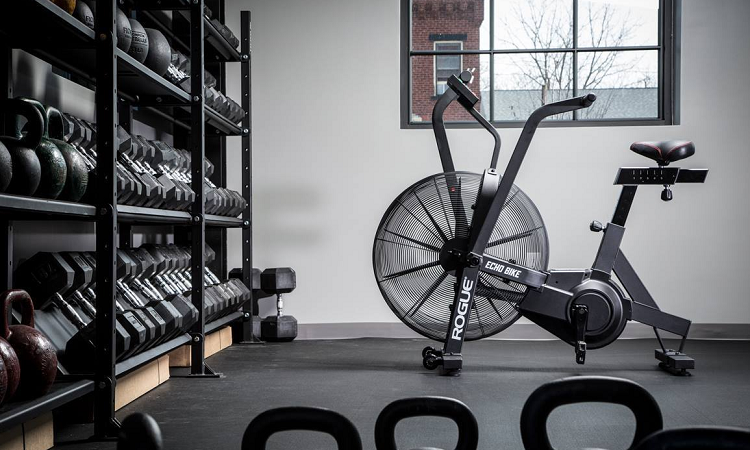
An Echo bike is also a stationary air resistance bike that’s designed for home use.
It uses air resistance just like the assault bike does, so you can scale your workouts to match exactly what you need them to be and based on your input. The more you pedal, the stronger the resistance gets.
Rogue’s Echo bike also comes with some advancements over the assault bike.
It’s a different brand that wanted to take a bit of the market from the assault bike and, despite commonly being priced higher, it does a good job at providing some competition for the king of air resistance bikes.
Pros
- Fantastically Durable Frame: The Echo bike did one thing right, and that’s making one of the most solid steel frames that we’ve ever seen. It’s a little bit heavier than the assault bike, sure, but it’s for good reason. This thing isn’t going anywhere. The extra weight can be attributed to the manufacturer’s desire to keep this in place and not skidding on the carpet from intense use, and it works a treat.
- Rubber Wheels: You can prop this up and wheel it around. You’ll notice wheels towards the front where the pedals are, and they surprisingly come in handy even if you just want to reposition this a little bit. They’re made from high-quality rubber that won’t leave track marks or streaks on the floor, which is something that many fitness machine brands fail to do, so good on Rogue for this one.
- Low Maintenance Design: You don’t really have to do much once this is constructed. It’s a very low-maintenance design, making it easy to own without headaches down the line. Greasing the metal parts every now and again is recommended regardless of what at-home exercise machine you have, so it’s nothing out of the ordinary here.
- Smooth Fan Belt Operation: You’ll hear us talk about the fan belt being quiet later on, but the main benefit is that it just feels so smooth to use. While it doesn’t accurately mimic the feel of a mountain bike on the trail, it’s surely going to be preferable to some people who just want to get into their workout as quickly as possible without a ton of wind-up.
Cons
- Higher Handles: This can be subjective depending on the user, but we found the handles to be a bit too high and much less ergonomic. For a machine that you’re going to spend a good amount of time on, likely each day, it should feel a little more comfortable to use.
- Pricier Option: No matter what sales go on or when you decide to buy, the Echo does basically what the assault bike does, but it’s always just a little bit more expensive. This is a comparison review, mind you, and while the Echo is worth the money it’s still a thumbs down compared to the assault bike.
Comparison

Now it comes down to the wire. Let’s talk about what’s the same, what’s different, and what it all means. You’ll notice that people tend to be diehard Echo or really in the assault bike camp, so let’s find out why.
Similarities
- Monitor: Both of the monitors on these bikes, regardless of their generation, tend to be the same. The functionalities are the same, the screen brightness is around the same number of nits (if you can even measure it in nits). With the rise of smartwatches, apps, and FitBit still being relevant, these screens aren’t that necessary and it’s believed that both bikes take a cheap approach because the user is likely using something else to track progress.
- Weight and Weight Limit: Have a weight limit in mind? The Echo and assault bike both hold the exact same user weight of 350 lbs, which is fantastic considering that other bikes in this range cap off at 275 lbs or so, sometimes around 300 lbs. As for the physical weight, there’s a 17 lb difference. That’s not going to be huge when you’re moving it around, but it does make you wonder about the build quality, because a 17 lb difference between these machines, while they have the same user weight, has us curious. What’s the main difference in the frame design?
- Air Resistance: Both bikes use air resistance, which is probably the first thing you noticed about them. Even though there appears to be such a rivalry between these two bike brands, the main thing you need to know is that their air resistance works very similarly. You’re not getting a huge difference in experience from the Echo versus the assault bike.
- Calorie Targeting: With those screens, as minimalistic as they may be, you can set calorie targets. The machine is the only one that knows just how much your intensity translates to calorie loss, so at the very least, you’d might as well use it for this. The calorie targeting appears to be fairly accurate for both of these bikes, so that’s a good thing.
Differences
- Drive System: The Echo uses a belt-driven system, which is exceptionally quiet. While the quiet operation isn’t a requirement, if you’re using this in a confined area and don’t want to wake your significant other or your children when you’re exercising early in the morning, this obliges you pretty well. The assault bike uses a chain, which is a bit outdated, but it gets the job done. The only major issue here is that the chain can come off easier than a belt-driven system can, and if it does, it’s harder to get back on than a belt.
- Bulk: The Echo is a little bit bulkier than the assault bike, and it’s funny because they have similar weights. They’re not inherently harder to move from room to room, but the Echo’s bulk can make it difficult to find a space in your home or apartment for it to fit if you’re in a small space. While the difference is negligible, it’s still there and something worth mentioning.
- Spinning and Winding: Whether you use a chain or belt-driven system, it has a certain way that the momentum builds, and that the momentum falls off. The Echo is more responsive because it hits that peak momentum faster and comes down off of it quicker as well, but the chain of the assault bike can take an additional few seconds to wind down. This isn’t the kind of difference that should sway your decision, but knowing all the little ins and outs makes a difference when you imagine it being in your home.
- Price: This can fluctuate due to sale prices, but for the most part, you’re going to spend around $100 more on the Echo than you will on the assault bike. Yes, the assault bike came first, so Rogue wanted to build a better air resistance bike. They may have succeeded depending on what you think, but one thing’s for sure: they were not able to do it for cheaper. It’s important to know that during the writing process of this article, we saw the price fluctuate from a $100 difference to an $18 difference, so be sure to watch pages and use your favorite shopping plugin to notify you when you have a deal on your hands.
- Sound: When you sit in a room and test these things out, with absolutely nothing else going on around you, it’s plain to see that the assault bike is much, much louder than the Echo. The chain makes all the difference, so if you’re living with other people, you might run into a few noise complaints from your assault bike. The Echo’s belt-driven system is much quieter, although it lacks the rigidity of the assault bike and the authentic cycling experience that it gives, so weigh those together.
Which One is Better for Me?

The Echo will give more resistance, but the assault bike—as air resistance bikes are known to do—is still going to react to the way you pedal and give you variable resistance as a result, so it’s really all up to you.
We know it seems like we’re offsetting the final verdict onto your shoulders, but when you really get down to the nitty-gritty and the in-depth specs such as resistance levels, user weight capacity, and more, you find that these bikes are very similar.
Get Cycling Either Way
Assault bike, echo bike—either way, you should get cycling. Even if you wanted to use an elliptical bike, the point is to get your heart pumping and get the blood flowing.
There’s not a clear winner here; it’s subjective and all depends on what you value with your exercise.
For some of us, the assault bike works best thanks to its rigid exercise structure, but for others, the echo will speak volumes.
Whatever gets you cycling and getting in shape is what’s important here. Is the Echo overdone? Is the assault bike hype really worth it? That’s up for you to say.
Resources: