

Let's begin by affirming that building a workout plan is one of the best decisions you can take for your health.
Because workouts are not necessarily enjoyable, you may find yourself faltering before your goals are achieved without a well-thought-out plan. However, it's one thing to build a program. It's another thing to create a workable workout program.
When you want to build a workout plan, the first challenge is knowing where to start. There is a countless number of exercises to choose from. There's also the challenge of knowing what combination of workouts suits you precisely.
Knowing how to build a workout plan that works for you from multiple options is the most crucial step of all.
So many factors must come into play, including time, what your goal is, the equipment available to you, your limitations, and how much you're willing to spend.
The idea is to keep improving your physique, building better muscles, and keeping your heart in an excellent working condition.
If you're overweight with accumulated fat that you'll love to lose; you should lose calories. Getting these done may only be possible with a plan.
A workable plan.
Know Your Goals
There are numerous reasons people hit the gym or invest in one at home. Most people want to keep fit. That's not a bad thing because the fitter your body is, the healthier you are.
Others want to lose weight, maybe look better or correct a health problem. Others are athletes who need routine workouts to remain in shape for the next challenge. You must know what your fitness goals are to have a plan.
Building a workout plan starts with fully knowing what the fitness goals are. Interestingly, no workout goals are too great to be achieved as long as the right tactics are deployed to address the problem.
The good news about fitness goals is that the results are often easily noticeable. And nothing encourages a person to pursue a dream than seeing evident results.
The most common fitness goal is weight loss, which involves losing calories and burning fat, mainly in the belly and the back. The problem is that many people do not know how best to address it.
That's where a plan comes in. You may be righteously following your workout schedule while failing your diet and lifestyle.
If your goal is to build muscles, you must also remember that diet plays a crucial role in your plan beyond the rigors of consistent exercise.
The first step in achieving this is knowing your fitness level. Many people are not aware of how urgent their need for a workout plan is because they don't know their fitness level.
Some people assume they are fit when they are not. You can access your fitness level by checking your body mass index, pulse rate, and how long it takes for you to get tired after specific exercises.
Understand Time Available

At the core of workouts is availability. You must understand the availability of time. Although we all have 24 hours every day, we all have different schedules and priorities.
How to build a workout plan depends on how much time you have. Some people can dedicate whole days to their workouts, while others may not afford such luxury.
Some people are only available at weekends, while others can only work out early in the mornings.
Before you plan your workout, understand how much time you have and what time of the day suits you best. Know how many days in a week you can spare and how frequent the workout can be.
Be Aware of the Equipment Available

Workouts can also be significantly affected by equipment. You can build a workout plan around the equipment available or unavailable, as the case may be.
Depending on your fitness goals, you may need specific equipment available at the gym. You may have to invest in them if need be.
Know your Limitations

How to build a workout plan also involves knowing your limitations as a person. You must know how much time you have, the equipment available, and what you hope to achieve in your workout plan.
If you are not as financially buoyant enough to have a registered gym membership, you can perform many exercises at home without equipment.
If you can afford a gym membership or buy some equipment at home, you must also consider your availability. Knowing your limitations helps you to build your plans around them.
You also need a lot of discipline. If no colleagues are willing to follow you up on your goals, you should be able to determine how best to keep yourself on the line when the road gets tough.
Have Patience

Patience is an essential part if the equation. You cannot build the desired body specifications overnight.
A lot of patience is needed. You also need a lot of consistency and determination. Even when properly implemented, a plan may still take time to produce results.
Without patience, you may want to give up on your plan. Exercise is not something you do once and for all. It has to become a part of you.
As noted earlier, you may also need to incorporate a diet into your plan. Depending on your goals, corresponding diet plans would complement your effort.
Examples of Workout Plans

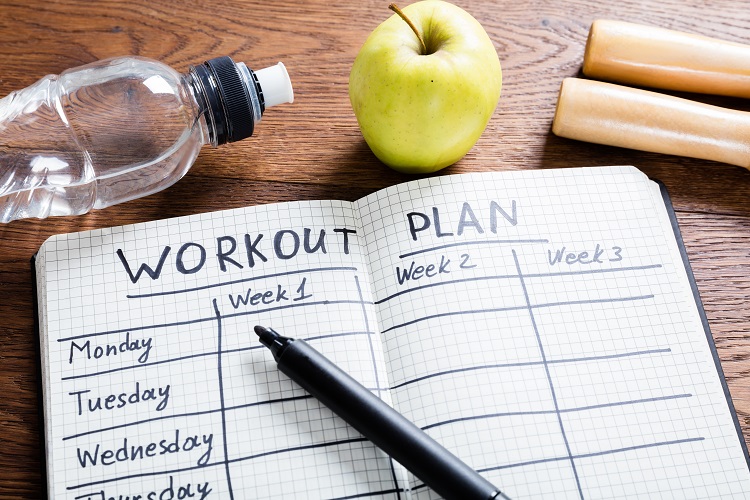
To create a workout plan, you can either use a manual or a digital method. It's just a to-do list of what activities you must carry out at the appropriate time.
There are digital tools on mobile devices that could create workout plans. You could also draw out a plan on your computer.
As noted earlier, your plan should be determined by your goals. If your goal is muscle-building, you need lots of weightlifting and body-building exercises. You could have a plan that goes this way:
- Monday: Arms/Shoulders
- Tuesday: Chest
- Wednesday: Rest
- Thursday: Full body
- Friday: Rest
- Saturday: Core
- Sunday: Legs
Each day, following the plan above, you can fix different exercises that target the part of the body being worked on. For example, on Saturday, you're focusing on the core muscles.
The recommended activities, which should begin with a warm-up, would include plank exercises, twists, bugs, and bicycle exercises. Every workout should also end with a cool-down session.
When you've considered your goals and limitations, you can build a workout plan that will fit your schedule; you can also consider using an automated fitness plan generator, which uses your personal preferences to design a workable workout plan for you which can be changed at any time.
How Long Should you Spend Each Day?

One also needs to consider how much time one has. We highlighted a workout plan above, considering a person who could work out five days in the week (with two days of rest). Not everyone has that much time.
But if you can work out as suggested above, you should spend as much time as necessary to perform about eight or nine different exercises in about three sets of 10-15 reps each.
Remember, you need to warm up and cool down before and after each workout session. That may take some people between 45-60 minutes for the average person. For professionals, it may be faster, and for beginners, it may be slower.
Some Other Important Factors

- Be specific: Even if your goal is to keep fit, it is a goal. Know what you're looking for in a fitness plan. If you don't have a specific purpose, measuring it would not be easy. If you have many goals, take it one step at a time.
- Start slow: Don't be tempted to go at it all at once. Take it slowly, one step at a time. If you plan to lose weight, don't put yourself under a lot of stress, or you may give up on your dream too soon. Start small, and improve progressively.
- Keep improving: After some time, you'll realize that you've mastered some exercises. Go for more challenging variations and keep improving.
- Measure your progress: Nothing gives a sense of fulfillment like seeing evident progress. Measure your progress occasionally. If you can't notice improvement, make your exercises more intense or change your plan.
Conclusion
Every successful fitness goal starts with a plan. If you have a program that can address your goals, you are on a successful journey towards building a fit body.
Learning how to make a workout plan requires putting several factors into consideration. If you can put all of the factors, like time, equipment, and goals, into making your workout plan, it becomes very easy to fulfill your dream.
Remember, you will not achieve your goals overnight, but with patience and consistency, you will.
Resources: