

If you are wondering how to get a good workout using customized tools from the comfort of your home, the box jumps DIY is an exercise tool you might want to consider.
Using the box jump or plyometric box jump involves rapid stretching and jumping that targets and works large muscle groups in your body.
This article will provide step-by-step instructions on how to make a jump box. While you can simply buy one if you prefer, the box is easy to make at home.
Read on to learn how.
Is Box Jumping A Good Exercise?

Box jumping is an excellent exercise commonly used for working the lower body. Its primary function is to boost your explosiveness, speed, and power.
When used correctly, box jumps can improve your overall performance, encourage you to try out some workouts you may have been avoiding, and reduce your risk of injury.
Box jumps exercises are extreme aerobics designed to stimulate your muscles and bring out maximum force in short periods.
The workouts push your muscles to their highest endurance levels. Little wonder the exercises are capable of making your muscles grow somewhat faster.
While box jumping is commonly used by well-trained exercisers and people who are very physically fit, it is also a good exercise tool for people who are just starting their exercise journey.
However, you should combine the use of box jumps with various other exercises. Also, even if you are not very physically fit, you can use these workouts as a fat burner because it is a high-intensity exercise and it is very effective for fat burning.
However, you should use them cautiously if you are overweight because they can cause some serious problems for you. If you push your body too far, it can strain your muscles and ligaments.
Making a box jumps DIY project is a great way to get in lots of plyometric workouts. You can use fiber-filled polymers or plywood materials to build one for yourself.
Buying A Jump Box Vs Making One Yourself

Jump boxes are a good addition to your exercise routine. But should you buy one or build it yourself? To help you decide, try to answer the following questions:
- Can you easily access jump boxes?
- Which jump box should you buy?
- How many jump boxes do you need?
- What height should you get?
- Are jump boxes good for your weight loss goals?
- Do you plan to use a jump box daily?
- Will jump boxes increase your muscular strength?
Considering that a typical jump box is made of pieces of plywood, buying the structure is rather expensive for what it is. It is a lot cheaper to build one.
However, buying a jump box can save you all the efforts and hassles of constructing one.
Also, you need to understand the steps to make box jumps DIY projects if you opt to build them yourself. You must find the right materials and tools for construction. And even then, can you make them as perfect as what you will get from the market?
These are what you should consider before embarking on building a DIY jump box. Thankfully, the steps are not too complex to understand, and just about anyone with some DIY skills can construct a solid box jump.
If you’ve decided that building box jumps DIY is what’s best for you, the rest of this article will show you exactly how to go about making your very first jump box.
How To Make A DIY Jump Box
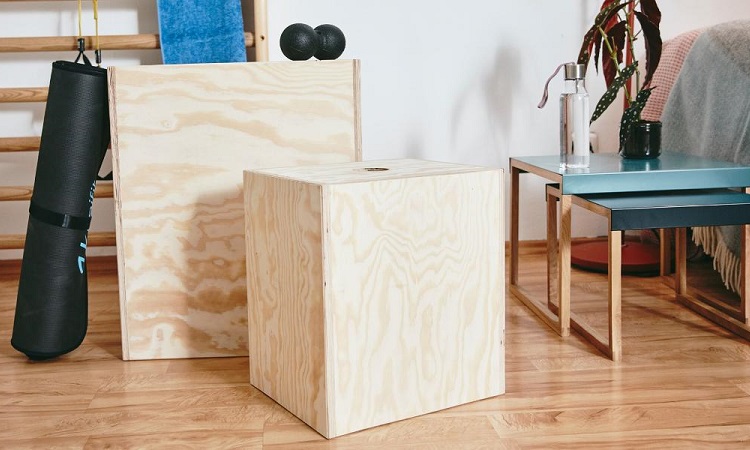
Tools and Materials
Here are the tools and materials you will need to make a jump box or plyometric box.
- 8 by 4 feet (2.4 by 1.2 m) plywood
- 2.5 inches coarse all-purpose screw
- Skill or table saw
- Drill and drill bit
- Screwdriver
- 24 inches straight edge rulers
- Permanent marker
Step-by-Step Guide
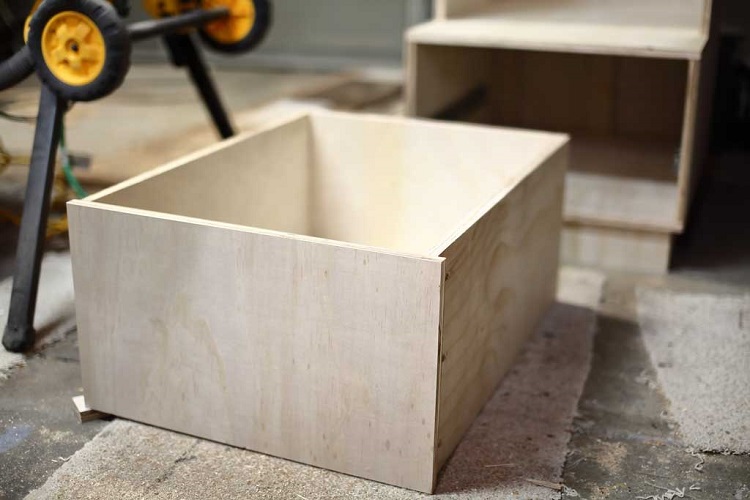
Here are all the steps you need to complete the DIY project.
Step 1
Buy an 8 by 4 feet (2.4 by 1.2 m) piece of plywood. Cut about six rectangles from the plywood with three different dimensions to form the sides of the jump box.
These pieces of plywood are wide, so you will need a vehicle to convey them if you are buying in person and not ordering.
Step 2
Take measurements and mark your plywood. You will need the following measurements when building a jump box:
- 6 rectangles of plywood
- 2 sets of 28 by 20 inches (71 by 51 cm)
- 2 sets that are 28 by 22.5 inches (71 by 57 cm)
- 2 sets that are 22.5 by 18.5 inches (57 by 47 cm
This is why you should get 8 by 4 feet (2.4 by 1.2 m) plywood to allow you to get up to six rectangles of the right size.
Next, use a marker to tick the spot you have measured out for cutting.
It is important to completely draw out the rectangles. They will serve as your guide when cutting the plywood so you don’t make mistakes (cutting too small or too large).
Step 3
Next, grab a saw and cut out the rectangles you have marked. Be careful when you cut the plywood along the marked points.
And while you do this, be sure to use your hands to hold the wood so that it is steady and easy to cut out.
As soon as you are done cutting, remove the piece from the complete plywood and set it aside to enable you easily cut the remaining sides.
Remember to wear safety goggles and hand gloves to prevent accidents!
If you don't have a saw or you don’t know how to use one, it is okay to ask someone at the hardware store to do the cutting for you after marking them out. However, this might cost you a few bucks, especially if it is not your first time asking for help.
Step 4
Assemble the box by hand to see if the pieces fit. This step is crucial to avoid taking everything apart after completing the box jumps DIY project and you discover something isn’t quite right.
Here’s what to do:
- Put one of the 22.5 by 18.5 in (57 by 47 cm) rectangles on the floor as the base of the jump box.
- Next, put the 28 by 20 in (71 by 51 cm) pieces on opposite sides of the bottom rectangle.
- Put the 28 in (71 cm) sides going upward
- Put the 20 in (51 cm) sides on the part of the bottom rectangle that is 18.5 inches (47 cm) long.
- Add the 28 by 22.5 in (71 by 57 cm) rectangles to the remaining sides of the bottom rectangle
- Now add the 22.5 in (57 cm) side to line up with the 22.5 in (57 cm) edge of the bottom rectangle.
Make sure your pieces of plywood are accurately lined up or else you will have to re-cut or go back and make amends.
Remember, to double-check before putting them together to avoid having a wobbly jump box. You don’t want to end up with an ineffective box that won't serve its purpose.
Step 5
Apply glue to each edge that touches a different edge. Use quality glue on the ends of each piece. Do this one at a time before putting the pieces together.
After applying the glue, allow the pieces to sit for about 15 minutes to dry. Now, tidy up the pieces by removing excess dried glue.
Step 6
Connect the pieces with drill wood screws.
- Put the wood screws about 4 to 5 inches (13 cm) apart and drill them on all four sides of the top and bottom piece.
- Next, drill wood screws about 5 inches (13 cm) apart along the left and right sides of the 28 by 22.5 in (71 by 57 cm) rectangles.
As much as possible, make sure to have screws connecting each piece of plywood firmly to each other.
Step 7
Allow the box to sit for at least 2 hours before trying it out. This will give the newly constructed jump box enough time to completely dry before testing it.
Before you start using it, press the box with your hands to be sure it is sturdy. Climb on and lightly jump on it.
Once you are sure it is completely strong and safe, you are good to go!
Conclusion
Box jumps DIY requires a few simple steps to make. With the right material and tools, you can do it on your own. It doesn't require any expert knowledge.
However, you should be careful with every cutting and coupling, as this phase requires accurate calculations.
And if you feel you don't have the time or energy to build a DIY box jump, you have the option of buying one that’s already made.
Resources: