
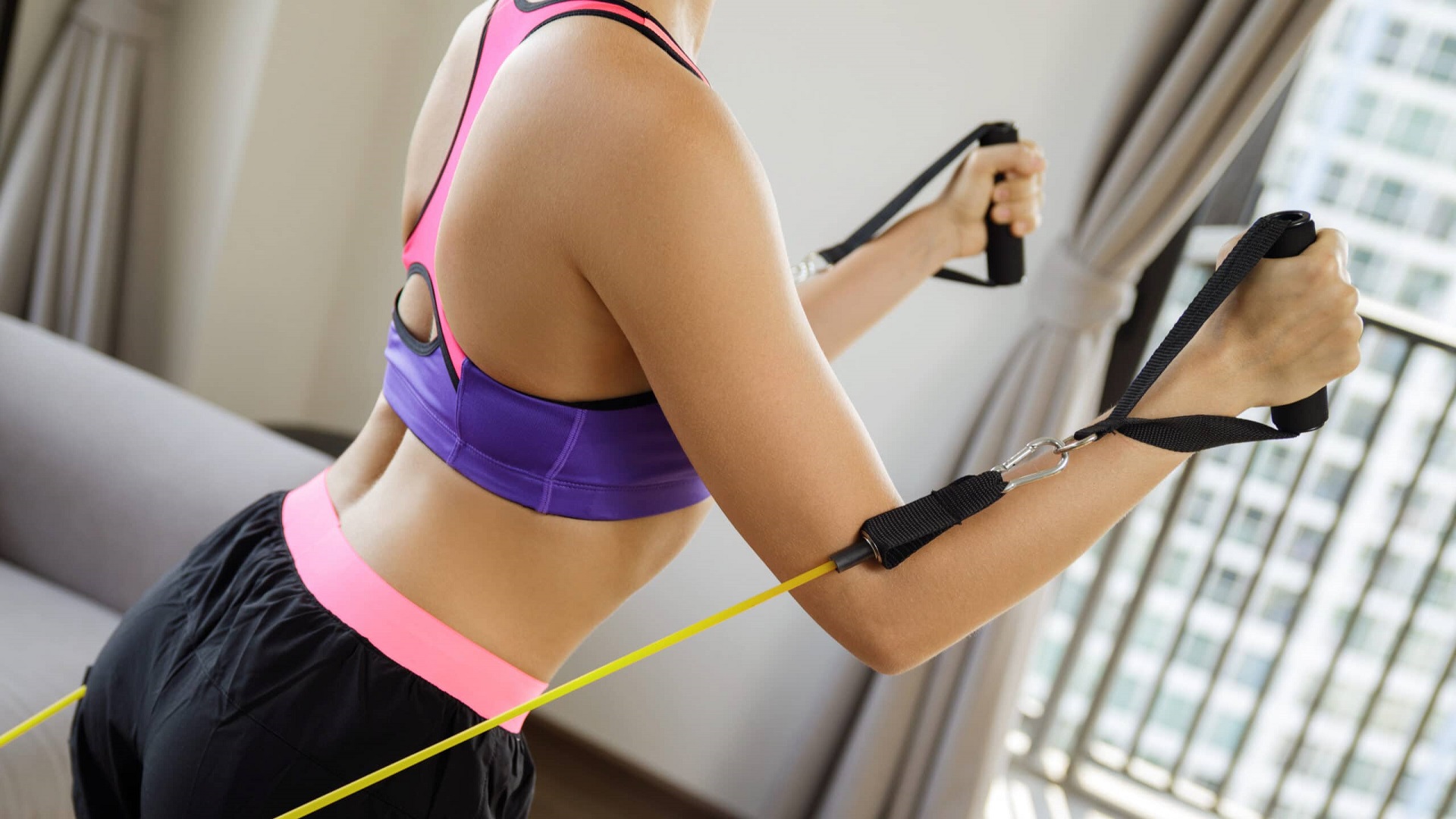
Don’t have ready access to barbells, dumbbells, and iron plates?
No worries.
You can still increase your chest muscles by using resistance bands.
Chest workouts with resistance bands might look too simplistic, but they are a great training tool and offer impressive benefits that are at par with other popular chest training tools.
In this guide, we’ll go through some of the best chest exercises you can do using resistance bands.
Before you use a band, though, inspect the band to make sure there are no frayed points. A frayed resistance band is a disaster waiting to happen!
Top 7 Effective Chest Workouts with Resistance
#1 Resistance Band Push-up
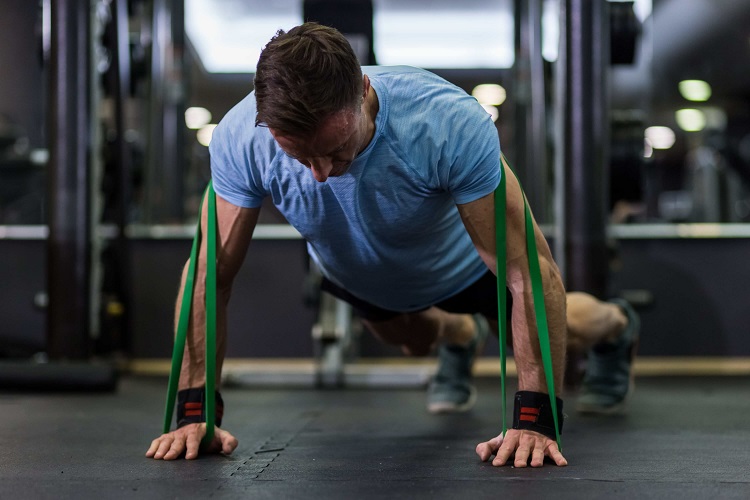
You are already familiar with the classic push-up (or press-up) but this variant is a bit harder to do because of the resistance.
It involves placing the resistance band across your upper back and doing the regular push-up.
Adding resistance to your normal push-up workout is a brilliant move because it puts your chest muscles under constant tension and works the chest harder.
Benefit
When done correctly, this exercise will activate the pectoral muscles and improve your overall upper body strength.
But that’s not all.
It works the abs, upper back, and muscles in your upper arm.
Plus, as you push yourself up, the forceful muscle contractions created by the resistance band improve your triceps lockout strength.
Generally, introducing resistance bands into your regular push-ups is a more efficient way to increase your performance instead of merely doing more reps.
How to Do the Resistance Band Push-Up Exercise
- Wrap the band across your upper back, just below your shoulders
- Put your palm through the loop at both ends of the resistant band
- Get into a plank position with your hands at shoulder-width apart on the floor
- Fully extend your legs with your chest out and back straight
- Inhale and as you lower yourself until it nearly touches the floor
- Make sure to keep your elbows away from your body
- Exhale and push back up
- Do about 8 to 12 reps for 1 set
Pro Tip: To develop explosive speed and power, use a weaker resistance band and move at a faster pace. To build strength, use a stronger resistance band but do the push-up at a slower speed.
Alternative Move
You can modify the move by doing a deficit push-up. That means doing the push-up by placing your hands on a raised surface.
This creates more stretch on your muscles and significantly improves muscle strength. That’s mainly because the elevated surface slightly increases your range of motion.
#2 Resistance Band Floor Press
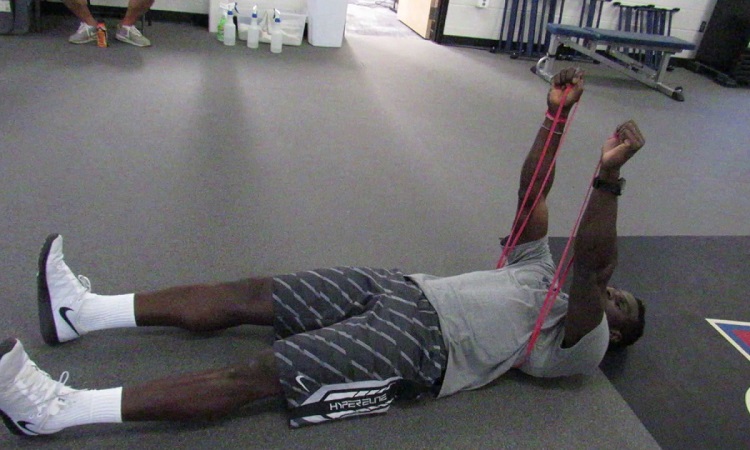
This is one of the best workouts with resistance bands that won’t put too much stress on your shoulders.
The resistance band floor press is an excellent way to target your chest and triceps using a limited range of pressing motions.
Throughout the movement, keep your focus on contracting your chest and triceps. Also, remember to keep your upper back contracted for the duration of the exercise.
Benefit
In addition to working the chest and triceps, this move reinforces scapular retraction and proper back tension.
In other words, it will create additional stability in your shoulders so you can do more bench press and push-up exercises.
How to Do the Resistance Band Floor Press Exercise
- Sit on your mat with your feet flat on the floor and knees pointing up
- Place the resistance band across your back, just below your shoulders, and hold the ends in each hand
- Now, lie on your back and bring the band above your chest with your palms facing up
- Push upward until your arms are completely straight
- Hold for about 3 seconds
- Gently lower your arms to the starting position
- Do 10 to 12 reps for 1 set
Pro Tip: Remember to bring both hands closer when you get to the top of the move. Also, you want to keep your wrists straight when you do this exercise. Not straightening your wrists may lead to injuries.
#3 Banded Pullover
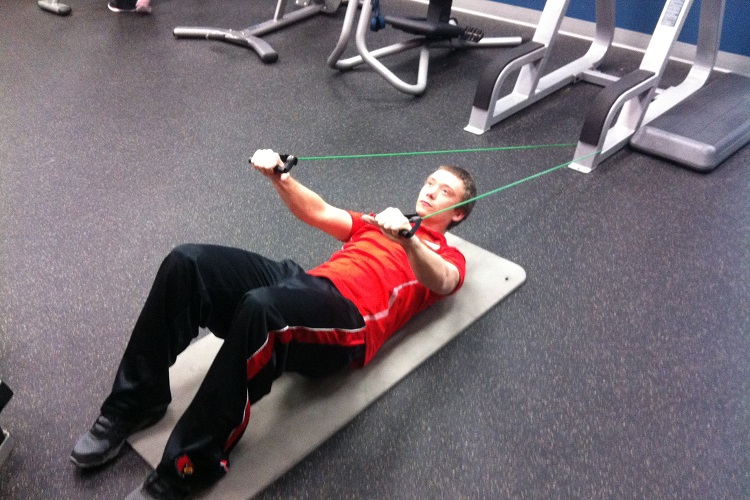
Picture a conventional pullover, but instead of the classic dumbbell or barbell, this variation uses a resistance band.
As one of the highly effective chest workouts with resistance bands, the banded pullover targets your upper body, including the shoulder muscles, back, and of course, the chest.
It is always a good idea to start the banded pullover with a thinner band.
This will slightly reduce the resistance and make it a bit easier to get the right form. You can increase the band’s thickness once you nail the perfect form.
Benefits
This is a great exercise to target your pecs as you lift and work your triceps and lats as you lower your hands.
You’ll get better mobility as the move loosens any tight muscles in your triceps and shoulders.
This is because the banded pullover allows you to stretch your shoulders and triceps further than you would naturally stretch.
And if you stay within the range of about 12 reps or thereabout, the exercise can help you build power, strength, and mass.
You might even improve your performance with pulldown or other types of upper body lifts.
How to Do the Banded Pullover Exercise
- Secure loop or anchor the resistance band to a workout bench (a sturdy table leg, door jamb, or any point low to the floor will do if you are doing this at home)
- Lie face up on the floor
- Extend your arms over your head and grab the band using both hands
- Keep your arms straight as you bring your hands in front of your head and line it up with your chest
- When your hands get to your chest, squeeze your pecs and hold for a few seconds
- Return to the starting position
- Do 8 to 10 reps for 1 set
Pro Tip: You’ll most likely find it easy to use a flat resistance band for the banded pullover exercise. Options with handles can get in your way.
Alternative Move
Want to take the challenge to your pecs up a notch? Here are slight tweaks for maximum gains.
First, keep your hands as close together as you can throughout the move. Secondly, bring your hands in as you pull the band toward your chest so that your palms are facing away from each other.
#4 Resistance Band Chest Fly
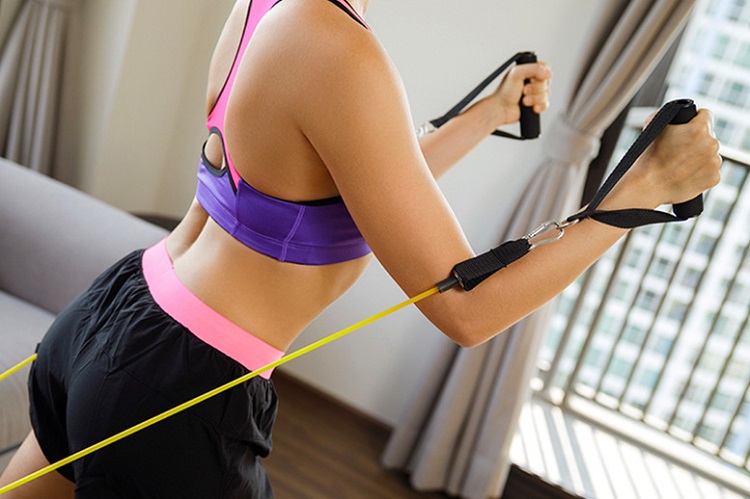
This is the classic chest opener exercise. As a single-joint movement, it targets the large fanned chest muscle.
You’ll want to focus on doing the resistance band chest fly if you are looking for a more chiseled definition between your pecs.
It is also a great exercise for building the biceps and triceps mass.
Benefits
The resistance band fly chest is a great exercise to increase peak torque, strength, and muscle thickness.
How to Do the Resistance Band Fly Chest Exercise
- Wrap the band around a pole at chest height
- With the resistance band behind you, grab the ends or handles in each hand
- Step away from the pole until the band stretches slightly
- Bring your arms up to shoulder level so it is parallel to the floor
- Keep your back straight, engage your core, and slightly bend your elbow as you bring pull the band forward across your body
- Using your chest muscles, bring the band together in front of you allowing your hands to almost touch
- Hold briefly and return to the starting position
- Do 8 to 10 reps for 1 set
Pro Tip: For better stability, keep one foot in front of the other throughout the move.
Alternative Move
Modifying this move is pretty straightforward. Simply loop the band underneath a bench and perform the exercise.
You can also anchor the resistance band to a pole at hip level and grab the handles with your palms facing the ceiling to do a lower chest fly.
#5 Resistance Band Row
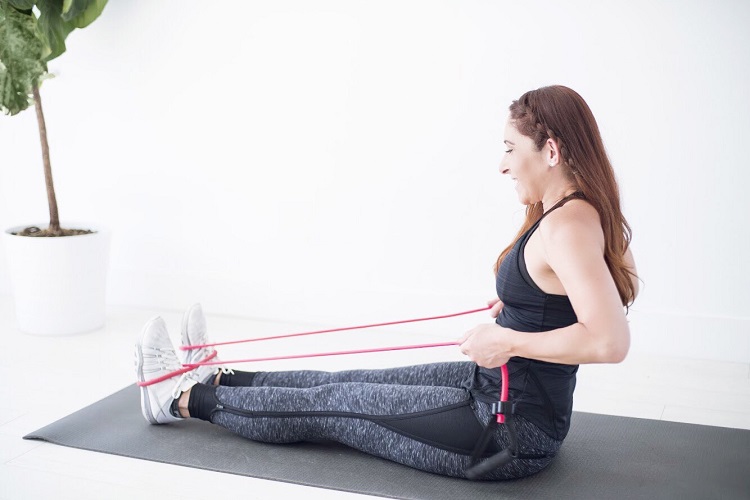
If you are a strong lifter or bench presser, you probably already will need a strong back to do squats, bench presses, and deadlifts.
But if your back strength isn’t as strong as you’ll like it to be, then a chest exercise that also improves back strength and power should be top on your “exercise to do” list.
That’s where the resistance band row comes into the picture.
This variation of chest workout with a resistance band builds your back strength as well as reinforces proper back positioning.
Benefits
The Resistance band row is effective for stabilizing your shoulders.
But that’s not all.
You can use it to strengthen the upper back muscles between your shoulder blades. The exercise works the lats, mid traps, and rhomboids.
How to Do the Resistance Band Row Exercise
- Sit on the floor in a rowing position with your legs fully extended and feet close together
- Loop the resistance band around your feet and grab the ends in each hand
- Squeeze your shoulder blades together to engage them
- Pull back your elbows and bring them near your torso
- Hold for about 3 to 5 seconds
- Slowly return to the starting position
- Do 10 to 14 reps for 1 set
Pro Tip: It is a good idea to vary the row widths, rep ranges, and grips to maximize muscle growth.
#6 Incline Chest Press with Resistance Band
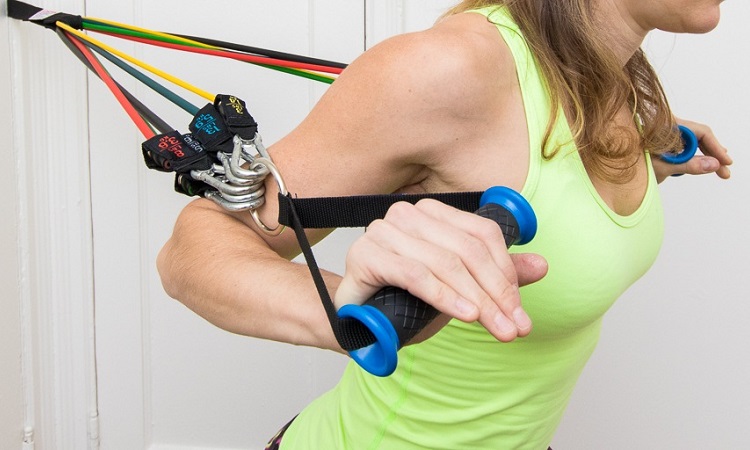
This is a go-to exercise for many people looking to have well-rounded chest muscles. Make sure to rotate your shoulders back and down to get the most out of this chest workout.
Benefits
This chest exercise is great to increase strength in any isolated chest muscles and is suitable for people of all ability levels.
How to Do the Inclined Chest Press with Resistance Band Exercise
- Anchor the resistance band to a door at around hip height
- Grab both ends of the band behind you and take a few steps forward until you feel a slight stretch in your chest
- Squeeze your shoulder blades and fully extend your arms as you bring your hand together
- Hold for a brief moment and slowly return to the starting position
- Do 10 to 12 reps for 1 set
#7 Resistance Band Straight Arm Pulldown
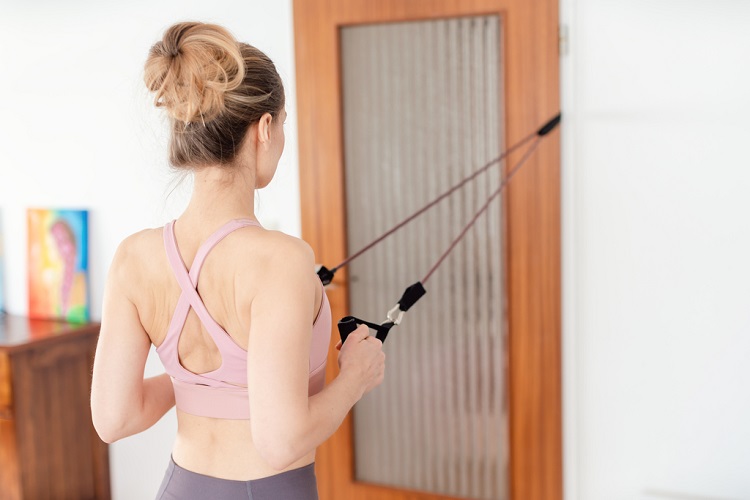
During pressing movements, you need support from strong shoulder and back muscles.
That’s why adding an exercise that works your lats and serratus anterior muscles is a great way to improve shoulder stability.
And there’s no better way to do this than using the resistance band straight arm pulldown workout.
Benefits
Unlike the traditional cable lat pulldown, this variation with the band allows you to work harder throughout the range of motion.
That’s because your lats get worked the most at the bottom of each rep.
In effect, the contraction of your lat will be maximized so you can develop a thicker and stronger back.
How to Do the Straight Arm Pulldown with Resistance Band Exercise
- Anchor the band to something stable and a bit higher than your head
- Grab each end of the resistance band in both hands and walk backward a few steps
- With your feet hip-width apart, lean your torso forward and bend your knees slightly
- Keep your arms straight as you raise them up in line with your ears
- Pull the band down to your thighs while squeezing your lats
- Hold for a few second at the bottom and release slowly
- Do 10 to 12 reps for 1 set
Conclusion
Chest workouts with resistance bands can be done almost anywhere. You don’t have to hit the gym to get the most impressive and well-defined pecs.
You can perform many of these exercise routines at home or even in your office! Thankfully, resistance bands are lightweight, compact, and are easy to pack.
Plus, unlike many other training tools, you don’t have to spend so much money to get one.
To top it all, you can increase your muscles with this seemingly simple tool just as though you were training with traditional weights and equipment.
Resources: