

The medicine ball has been popularly used as far back as the time of the ancient Greek physicians. This exercise is now influenced by soldiers and today's most elite trainers. The balls are simple to throw and catch, allowing for fast-paced action.
You can change up the traditional exercises by balancing with a medicine ball to target the deep core muscles of your body in a way that dumbbells won't.
The best thing about medicine balls is that they come in various weights and sizes, giving you plenty of choices.
Start with these simple medicine ball core exercises and incorporate them into your routine in multiple ways. Here are some of the best core exercises with a medicine ball:
#1 V-Ups
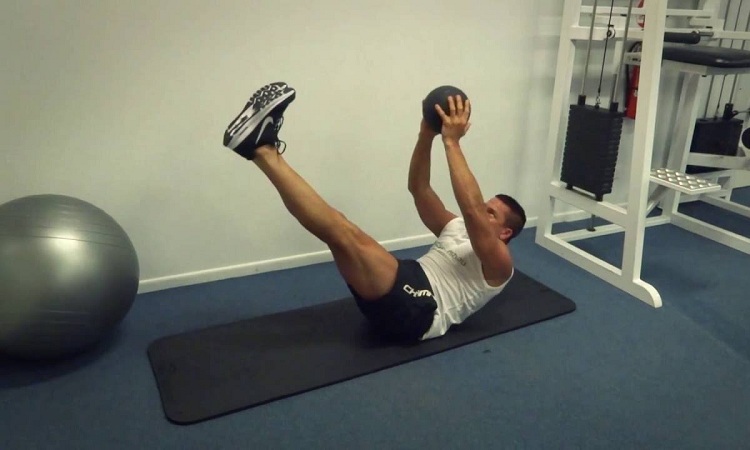
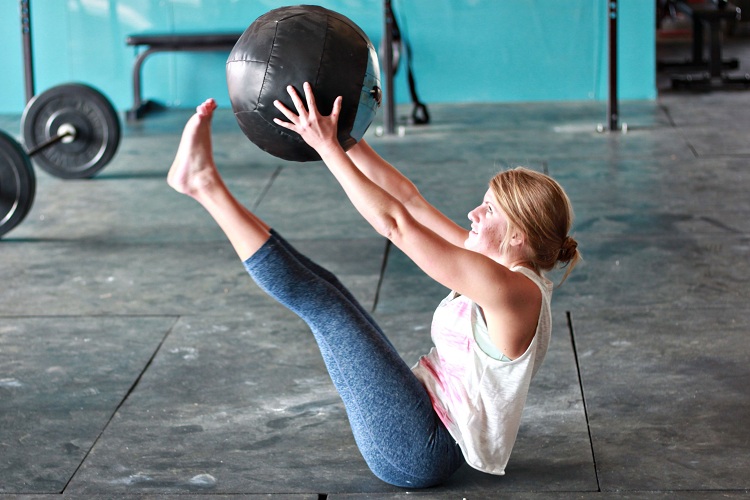
The medicine ball v-up is an excellent core-strengthening exercise. The rectus abdominis and transversus abdominis core muscles are the primary targets. It's a simple method that's easy to pick up.
To get the basic movement pattern down, beginners should start with a bit of medicine ball or no ball at all. You can then proceed to bigger medicine balls and various v-up variations.
How to
- Begin by lying on your back, arms behind your head (holding the medicine ball), and legs straight.
- As you lift your feet and hands to the point where the medicine ball meets your toes, brace your abs and softly press your low back into the floor.
- Return to the starting position gradually and repeat for a few sets of 8 to 12 repetitions.
#2 Russian Twists

The Russian twist is the next medicine ball workout you can try. This is yet another fantastic core workout that strengthens the obliques while developing core stability. If you're a complete newbie, start with a lighter medicine ball or no medicine ball at all.
How to
- Start by sitting with your back slightly tilted backward and your feet lifted an inch or two off the ground. Hold the medicine ball in your hands.
- Twist your torso to one side until your arms are parallel with the ground, then twist to the other side.
- Do 15 to 20 repetitions for several sets, avoid using momentum or allowing the feet to swerve around.
#3 Plank
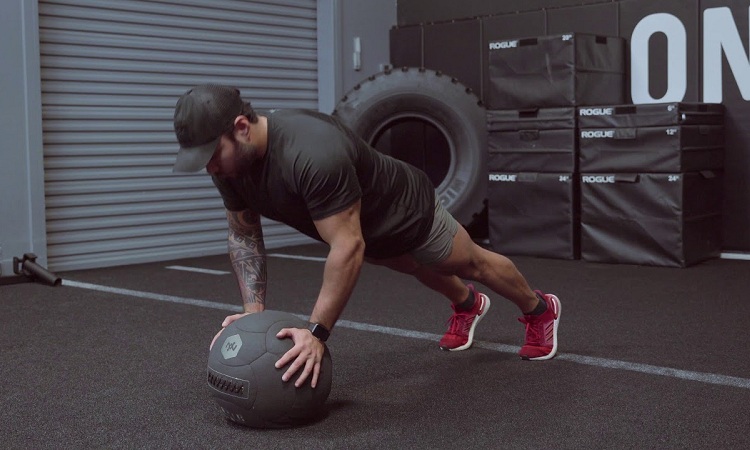
The basic plank is used for this exercise, but this time with a medicine ball which makes it more difficult. We all know how beneficial the plank is for increased stability and overall core strength as swimmers.
Because you're supporting yourself on an unstable medicine ball, the medicine ball plank is a terrific method to push yourself since your core has to work extra hard to keep you stable.
How to
- Kneel on the floor with your medicine ball in front of you.
- Push up on the medicine ball until your arms are straight and your complete body is in a straight line from head to toe.
- Try to stay in this position as long as possible.
#4 Thrusters
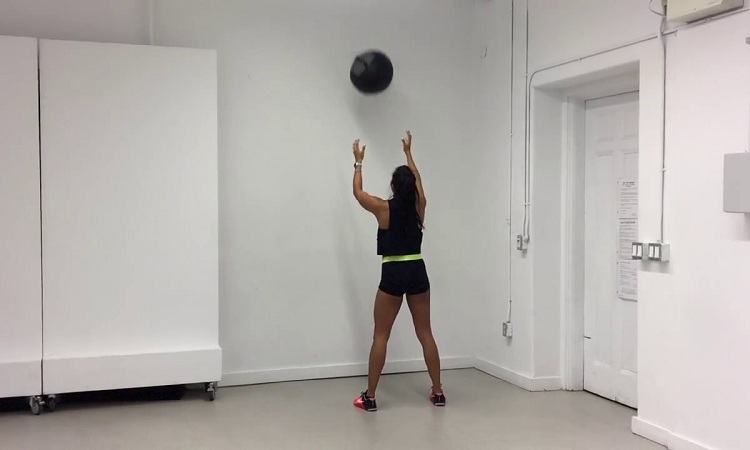
The medicine ball thrusters will be the first power med-ball workout you do. This workout engages the entire body, increases explosive power, and raises your heart rate.
How to
- Begin by assuming a comfortable stance and pressing the medical ball against your chest.
- Squat down, push back up and stretch your arms upward to press the medicine ball overhead.
- Focus on speed and power for 8 or 10 repetitions.
#5 Slams
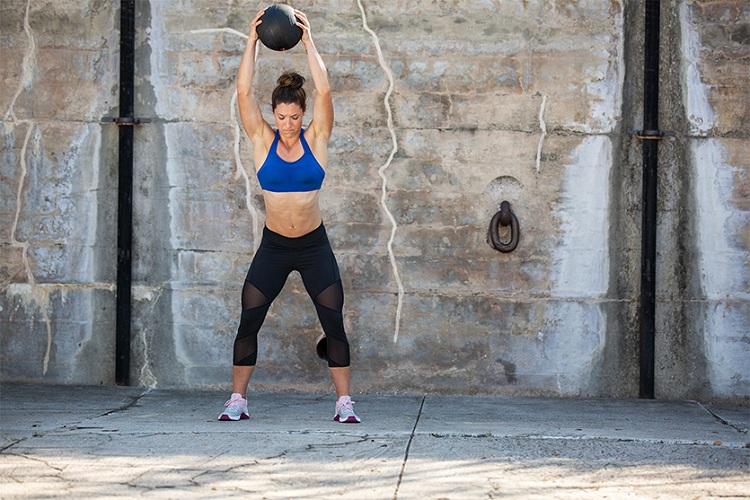
One of the most popular med-ball exercises is the medicine ball slam. It's an excellent way to increase speed and power while immediately raising your heart rate.
How to
- Begin by establishing a comfortable and steady stance with your feet shoulder-width apart.
- Take your medicine ball and hold it out in front of you at about arm's length.
- Tighten your core and smack the ball as hard as you can against the floor.
- As you raise the ball overhead, be careful not to lean backward.
- You can also squat and catch the ball as it bounces back up if you want to. To obtain the most benefit, perform several quick medicine ball slams.
#6 Squats
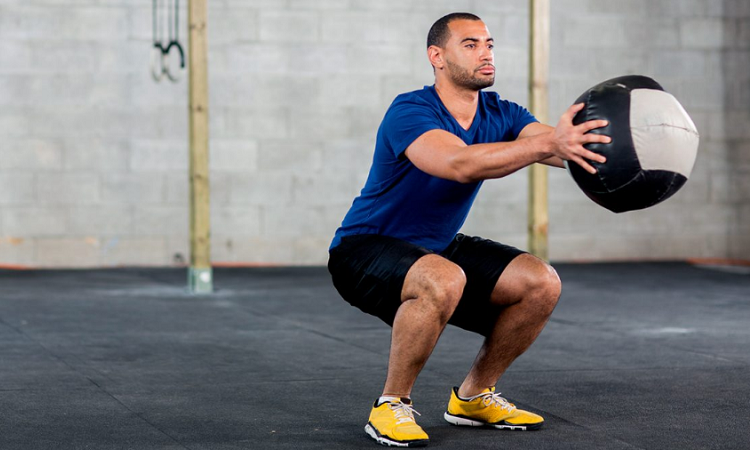
The medicine ball squat is an excellent lower-body med-ball workout for increasing leg explosive power and strength. This can lead to faster and more accurate starts, turns, and underwaters in your swim events.
How to
- Begin by assuming a comfortable and steady stance, with your feet shoulder-width apart and your toes pointed out slightly.
- Choose where you want to hold the medicine ball; it's common to rest it against your chest or behind your head.
- Drop into a squat, making sure you have enough depth, and then explode up as forcefully as you can into a vertical jump—rep for a total of 6 to 10 times.
#7 Toss the Ball Over the Back
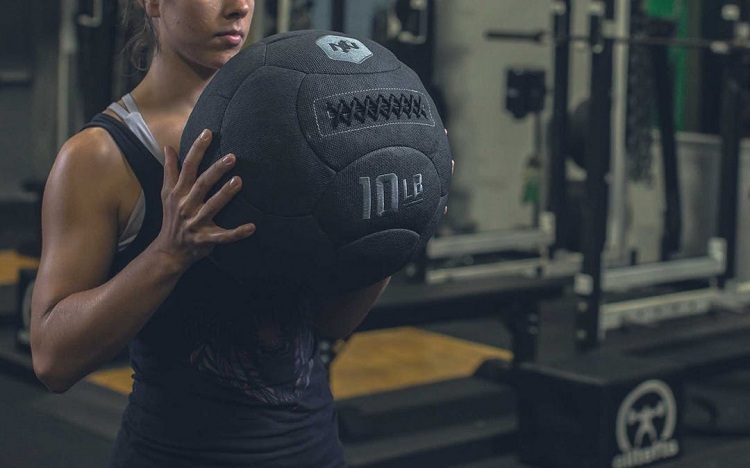
One of the finest techniques to get an explosive upper body power and speed is throwing or tossing a medicine ball over your back. After a few repeats, it becomes pretty tricky and is an excellent way to raise your heart rate.
How to
- Start with your feet shoulder-width apart and the medicine ball in a comfortable and stable stance.
- Extend your arms and toss the ball as high and far backward over your head as you can while bracing your core and upper body.
- You can get the ball and repeat the process, or you can have a partner throw it back to you. For a couple of sets, do 3–5 repetitions.
#8 Pushups
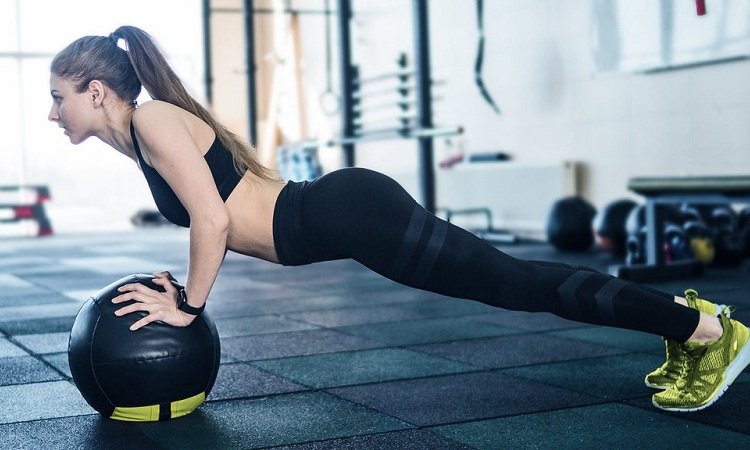
Next, we'll do some broader med-ball workouts and help with power development. As a result, the alternating ball pushup is a fantastic technique to strengthen your upper body while improving your speed.
How to
- Begin by putting one hand on the medicine ball and doing a pushup.
- Do a pushup, then swiftly shoot the ball to the other hand, elevating it.
- Rep the pushup and return the ball to your original hand as quickly as you can, complete 10 to 15 repetitions.
#9 Pushups with a Close Grip

Another great med-ball workout for strengthening your core is the close grip ball pushup. You can blast up after each rep to make it a more powerful movement.
How to
- Begin by performing a pushup with both hands on the medicine ball.
- Find a comfortable and steady stance with your body with your hands and feet while maintaining a straight line.
- Repeat for 6 to 10 repetitions with a close grip pushup.
#10 Jumping Chest Presses

This is a fun and explosive exercise that focuses on speed, power, and heart rate while also exercising a wide range of muscle groups.
How to
- Begin by assuming a comfortable leaping stance and holding the med-ball at about chest height in front of you.
- As if you were skipping with a jump rope, start by doing small, explosive jumps.
- Then, as you're jumping, throw the medicine ball to and from your chest. To get your heart rate up and muscles burning, repeat this for 30 seconds to a minute.
How You Can Use Med Balls

The medicine ball is best known for its usage in power development. Still, you're only limited by your imagination regarding the variety of exercises you can do with it. The primary instances can be found below.
- Throw: With your feet shoulder-width apart toss the ball into a wall. One or both hands should be used. Throws can also be done while kneeling, lying down, or jumping.
- Catch: Toss the ball against a wall and catch it as it bounces, or toss it back and forth with a partner like a game of catch.
- Lift: What if you don't have any dumbbells? As a weight, you could even use a light med ball. Squat with a circuit, press it overhead, and do lunges, rows, and ab twists or woodchops. Hold it in one palm and do Turkish getups as you would with a kettlebell to challenge your core with an offset weight. Would you like to train with the World's Strongest Man? You can carry it in your arms or overhead for distance or time.
- Balance: Put one or both hands on it and perform pushups to test your stability. To work your glutes, place your feet on them and lift your hips off the ground. Treat the ball like a hurdle and jump over it instead of touching it.
- Roll: Warming up and increasing mobility with foam rollers isn't the only option. On the ball, stretch your muscles. Even a soft-shell med ball with enough density to loosen tense muscles can be used for very sore locations.
Who Can Use Medical Balls?

One of the most frequently asked questions concerning medicine ball workouts is, "How can I know if I'm doing it right?"
And because there are so many activities, weights, and varieties of medicine balls, it's a simple question to answer. As a result, they can assist everyone, from beginners to professional athletes.
It's one of the most versatile pieces of equipment you can add to a training program because the exercises and the ball's weight will vary.
How to Pick the Right Weight for You
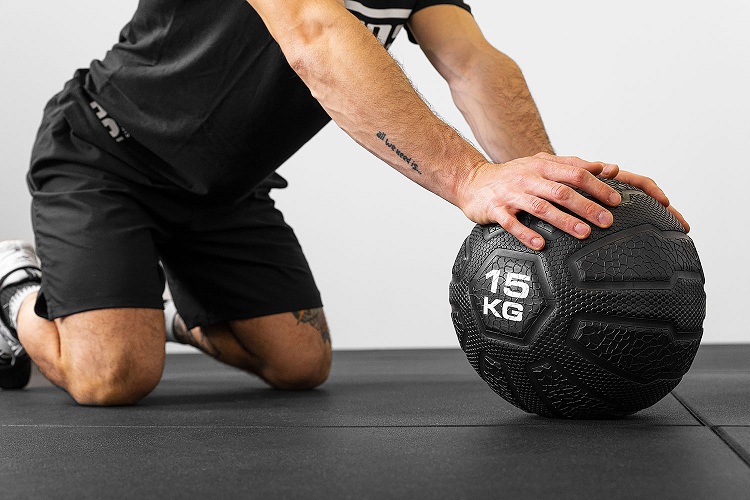
Several things must be considered when selecting a weight for the medicine ball. To begin, the workout you undertake will help you determine whether you should go light or heavy.
Next, consider the individual's strength; the more serious the medicine ball is concerning the workout, the stronger the individual is.
Then think about how many repetitions you need to make. Remember that lighter is better for more repetitions, while heavier is better for fewer repetitions.
Make sure that the weight you select does not restrict your mobility. You should complete the required number of repetitions fluid in an efficient manner. You shouldn't have to sacrifice range of motion, form, or repetitions.
The weight of the medicine ball may need to be increased over time as strength and range of signal improve.
Benefits of Med Ball Exercises
Increase your body strength and explosive power
The ability to put forth the absolute force in the quickest amount of time is called explosive power. When you tension a muscle, the more energy you can release, the greater force you can produce in the shortest amount of time.
This explosive power is based on physical strength in specific regions and motions influenced by training. Squats and ball throw, for example, are two examples of sequences that mix exercises with medicine balls.
Improve physical preparedness by improving speed and movement accuracy
Practicing with medicine balls can help athletes and players improve their speed and precision of motions while training and warming up for competitive sports.
Athletes can dynamically move their bodies, react proactively, and position their bodies while communicating with colleagues by replicating particular activities with these weighted balls.
Offer Versatile full-body workouts
Regardless of the primary muscle group targeted, medicine balls force you to engage more of your core muscles. You'll receive a complete workout this way, which means you'll burn more calories and improve your overall fitness.
As a result, switching your workout forms and mixing them up will help you uncover your total body potential.
Throwing and catching the ball, whether alone or with others, improves hand-eye coordination, body balance, and flexibility while allowing you to adapt to the ball's changing trends.
Efforts to recover from injuries should be stepped up

Medicine balls are pretty beneficial in rejuvenating the body's endurance and reaction, and they can help patients recover from injuries or procedures. Spinal, shoulder and knee ailments are the areas where they can most effectively treat.
Patients are frequently told to start with a light ball and progressively raise the ball's weight as their rehabilitation progresses. Additionally, some workouts can be tailored to improve the flexibility and strength of the thigh or calf muscles.
Improve your teamwork and socialization skills
While most gym workouts may be completed alone, practice with these weighted balls can be done with a partner to make the experience more enjoyable.
Enlisting the help of another person will broaden the range of training exercises and boost your attitude.
Rolling, bouncing, tossing, or passing the ball back and forth amongst team members can target different muscle areas during group training with a ball. By playing and practicing simultaneously, they will be able to boost their energy levels.
Conclusion
Overall, medicine balls are an excellent way to add variation to your boring workout routine. Many fantastic med-ball exercises may help you build strength and power, which will help you swim faster and better in the long run.
We strongly advise you to try out a few of these workouts and evaluate how they fit into your training routine. You don't have to use all of them, but some can be useful.
Resources: